
Dissecting the Practical Effects on the Cult Classic Film
“Never give up, never surrender!”
- Jason Nesmith (Tim Allen), GALAXY QUEST
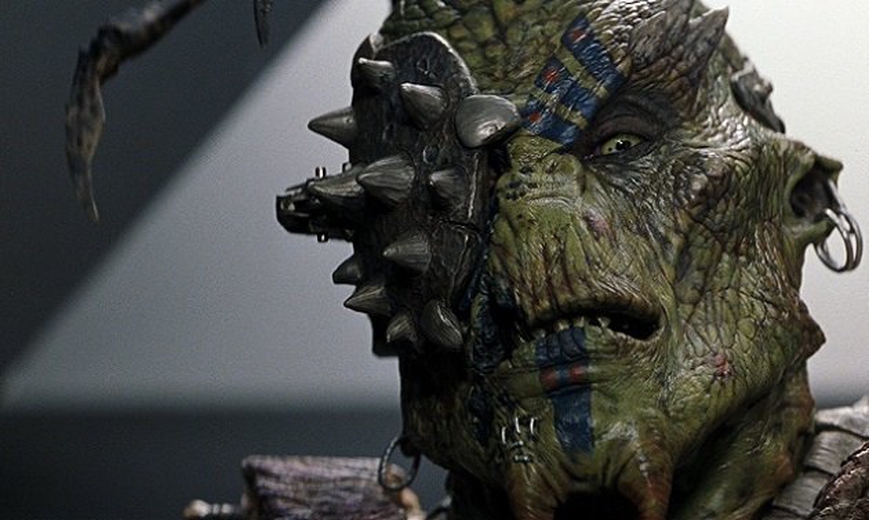
1999 was a busy year for Stan Winston Studio, and as the century came to a close, the studio's final project for the year was GALAXY QUEST. Dean Parisot directed the comedy starring Tim Allen, Sigourney Weaver and Alan Rickman as has-been stars of a canceled science fiction show--sharing a strong resemblence to the original STAR TREK series--who are sought out by real-life aliens, the Thermians, to save their species from extinction. Stan Winston and his crew created the "true forms" of the octopus-like Thermians, as well as bad-guy alien Sarris, his reptilian henchmen, and an alien Pig Lizard who suffers a sad fate. Designs for the creatures began with Harold Ramis attached as director, and continued under the direction of Steven Spielberg--whose DreamWorks Studio was producing the film--when Ramis left the project.
Jump To Section
- Building the Thermians
- Designing the Galaxy Quest Villain, Sarris
- The Making of Pig Lizard
- Coming Up With the Look for Dr. Lazarus
- Creating The Little Blue Aliens
Building the Thermians
Stan Winston’s crew built the Thermians--five large, brightly colored, cable-operated silicone puppets--separately molding forty-five tentacles for each one. The puppets were built, and painted. Performance was rehearsed and ready. And with only two weeks remaining before they were to be taken to the set for filming, Stan got a call from Steven Spielberg, saying he was not sure about the Thermian design. Upon review, Spielberg had decided that they were too bizarre, that they should look more humanoid, like the aliens in his CLOSE ENCOUNTERS OF THE THIRD KIND (1977).
 (Mark Crash McCreery’s fleshed-out rendering of a Thermian, based on a design by Simon Bisley.)
Stan Winston phoned supervisor Shane Mahan with the news. “I remember Stan saying, ‘Are you sitting down?’ And then he told me what Steven wanted to do. I couldn’t believe it. We’d gone to so much trouble for these things. And, at this point, we had only two weeks to come up with something entirely new. So I said to Stan: ‘Of course we’ll do whatever Steven wants. But these things are done, they’re great, and I think we should stick with them.’ Stan heard me out, and said, ‘Okay, let me call Steven back.’ I don’t know what Stan said to him, but after they talked, Steven decided that the Thermians were probably all right as they were. The Thermians were shot; and, in my opinion, they were just great.”
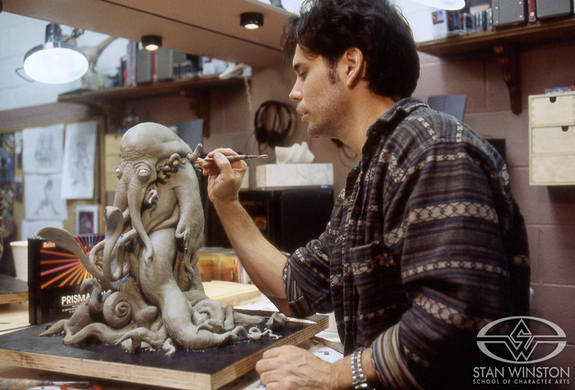 (Christopher Swift sculpts a Thermian maquette for GALAXY QUEST at Stan Winston Studio.)
 (Christopher Swift and Shane Mahan sculpt a Thermian head.)
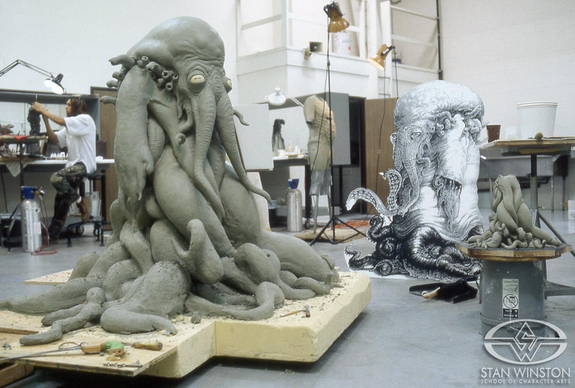 (Nearly finished clay sculpture based on the concept art and maquette (visible on the right side).)
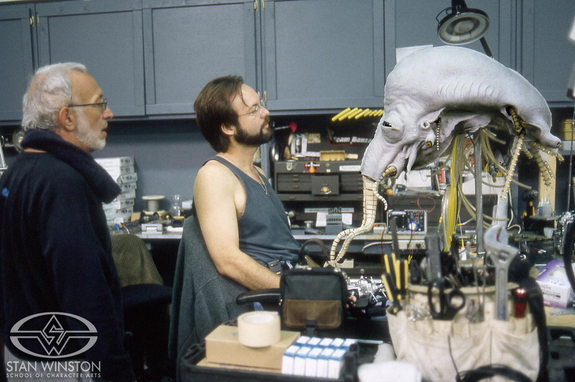 (Richard Landon demonstrates the inner workings of a Thermian puppet as Stan Winston observes.)
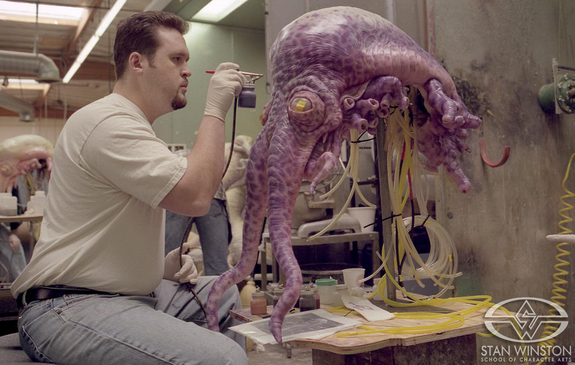 (Trevor Hensley adds paint details to the animatronic, tentacled Thermian puppet.)
 (The finished animatronic Thermian puppet.)
 (Animatronic Thermians and their transformation. Transformation CGI effect by ILM. (Note: after transformation, the middle Thermian is played by our SWSCA co-founder Matt Winston.))
Designing the Galaxy Quest Villain, Sarris
For the reptilian bad guy, Sarris, the mechanical department used a technology created initially for a PLANET OF THE APES project in-development, which enabled an actor’s facial expressions to be translated to an outer makeup appliance--a challenge Stan Winston had been working on, in one way or another, ever since he’d built the Wookie heads for THE STAR WARS HOLIDAY SPECIAL, twenty years earlier.
 (Christopher Swift at work on an early version of the Sarris design.)
“When we were testing things for PLANET OF THE APES,” Richard Landon recalled, “Stan came up to me one day, and said, ‘Figure out a way to make a transfer mechanism, so that an actor’s face can actually move a muzzle.’ This was another case of Stan saying, ‘I don’t know how to do this because I’m technically averse’ - and then exactly describing the mechanism to me. Just in the way he described its purpose, Stan had described the mechanism itself. It was just a little linkage device that made the makeup move when the actor’s face moved. And that’s what we used for the muzzle on Sarris.”
 (Sarris concept design by Mark Crash McCreery.)
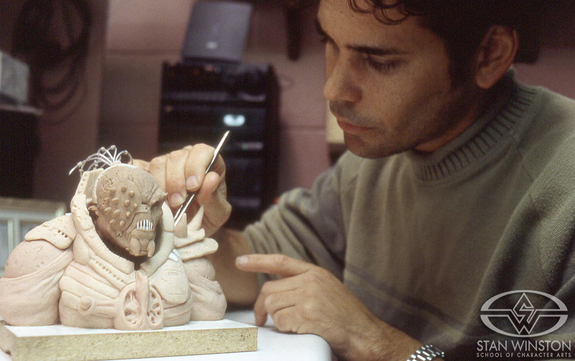 (Christopher Swift sculpts miniature Sarris maquette.)
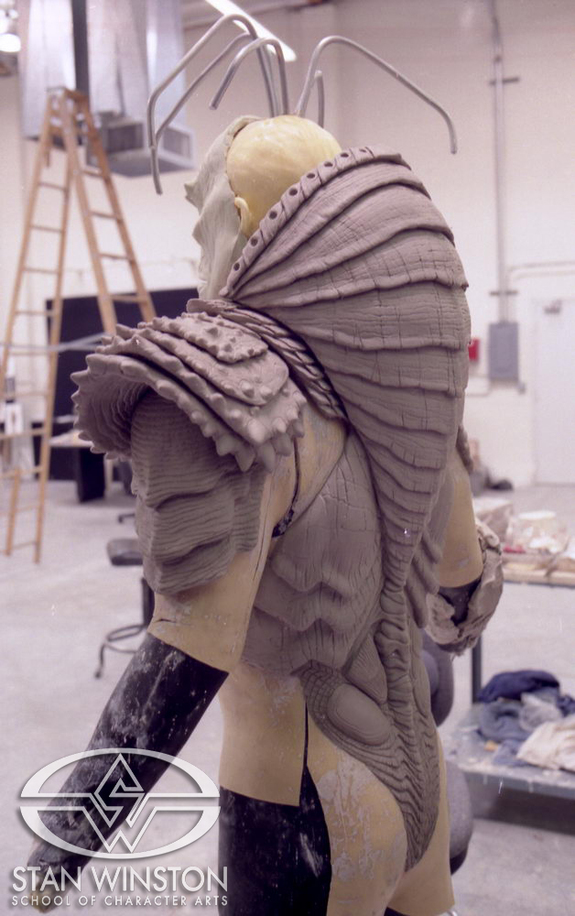 (Full-size clay sculpture of Sarris' back.)
 (Stan Winston and a crewmember with Sarris on the Galaxy Quest set.)
 (Actor Robin Sachs as Sarris in the final makeup and suit.)
The Making of Pig Lizard
Pig Lizard is a type of strange pig-like creature that Jason Nesmith (Tim Allen) fights before being attacked by the Gorignak. Later it is beamed up to the ship to test the mechanism for rescuing Jason from the planet with disasterous results.
 (An early concept for Pig Lizard by Jim Charmatz.)
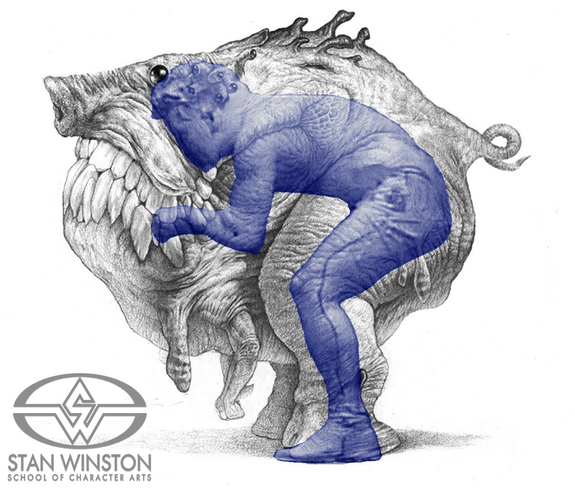 (Approved concept artwork that shows the suit performer position inside in the Pig Lizard.)
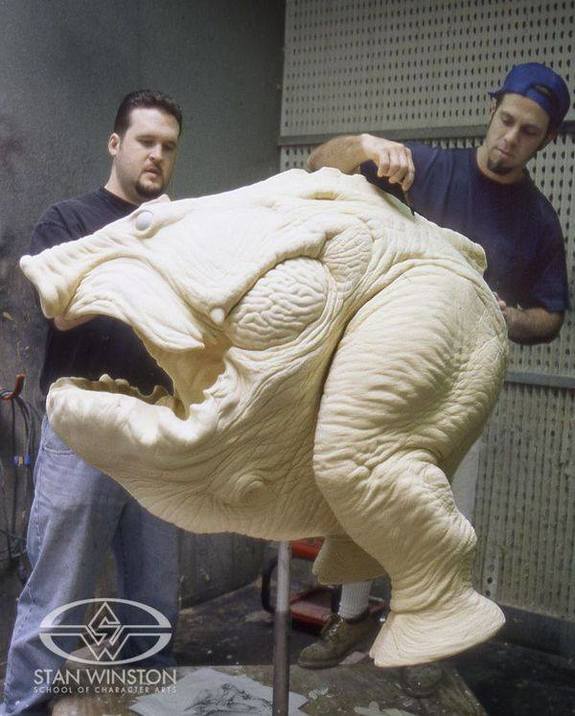 (Trevor Hensley and Rob Ramsdell prepare to paint the Pig Lizard.)
Watch the Pig Lizard test at Stan Winston Studio. Special Character Effects Supervisor Shane Mahan (inside the creature suit) moves around the SWS mechanical shop as he explores the bizarre extraterrestrial character's walking style:
Coming Up With the Look for Dr. Lazarus
In the film, Alan Rickman plays Alexander Dane an actor who is a part of the former cast of the now-cancelled space-adventure GALAXY QUEST TV series. In the series, his character, Dr Lazarus, is meant to be an alien. Here, Stan Winston Studio had to create an actual makeup that was meant to represent a piece of iconic, historic TV makeup!
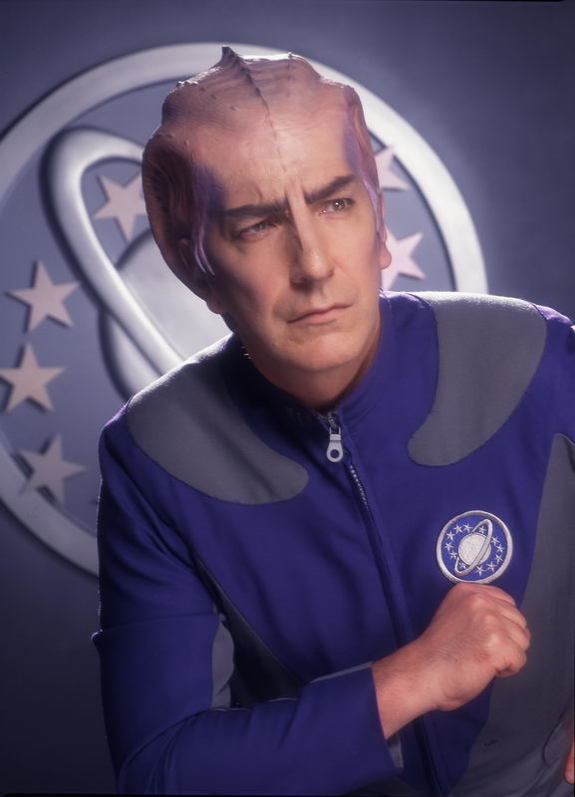 (Alan Rickman as actor Alexander Dane, in makeup as his Galaxy Quest character Dr. Lazarus.)
To create the iconic headwear, SWS crew first took a head-and-shoulder life-cast from Alan Rickman, then sculpted, molded and fabricated the prosthetics, which were custom painted.
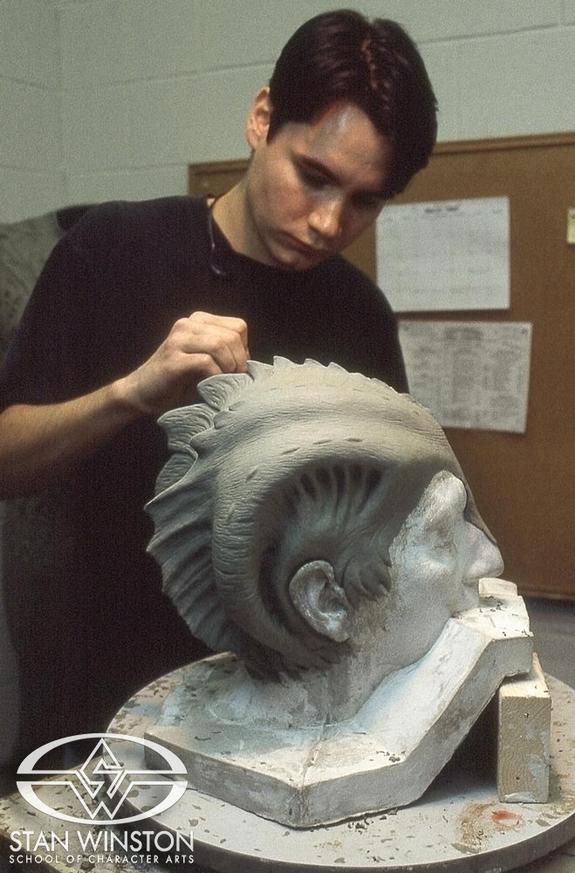 (Jason Matthews sculpts Alan Rickman's pseudo-alien headgear.)
 (Shane Mahan paints Alan Rickman's prosthetic pseudo-alien headwear.)
Creating The Little Blue Aliens

Bernie Wrightson created concept artwork for the blue baby/aliens and he kept these little blue creatures true to the script. The script describes them as looking like babies but displaying a mouthful of fearsome shark's teeth when they smile. Based on the concept artwork, Paul Mejias sculpted maquettes that were later scanned to create computer models for the animated characters.
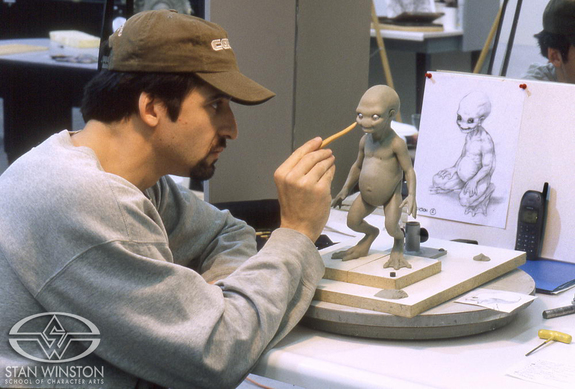 (Paul Mejias works from a Bernie Wrightson design to sculpt the blue baby maquette.)
 (Blue baby maquette with shark teeth and demonic look.)
The decade that came to a close with GALAXY QUEST was a period of unprecedented growth, prosperity, innovation and productivity for the Stan Winston Studio. Stan Winston and his crew created characters for twenty-four films during that time-frame. In the process, Stan picked up six Academy Award nominations and three statuettes. Throughout the 1990's Stan also found time to direct two films of his own. With the impressive accomplishments of a thirty-year career, Stan Winston could have closed the door to the studio and retired. Instead, he set out on decade number four, still enthusiastic about his work, still a big kid in love with monsters and the movies. Rather than slow down, Stan Winston would go on to create a toy line, publish comic books, prepare an art exhibit, establish a digital unit and a production company, and team with MIT on one of the most exciting explorations of artificial intelligence in the scientific community.
- Blog assembled by Adrienn Lingurár with selections from The Winston Effect: The Art and History of Stan Winston Studio by Jody Duncan
Courses with the Creators of Galaxy Quest
- Special Effects Sequence Design with Shane Mahan
- Hybrid Characters: Blending Practical & Digital FX with John Rosengrant
- Hybrid Character Design: Practical To Digital with Christopher Swift
- Animatronics Design Basics with Richard Landon
- Cable Mechanism Basics - Tentacles with Richard Landon
- Maquette Painting Techniques with Trevor L. Hensley
- Metallic Painting Techniques - Robot Finishes with Rob Ramsdell
- Hairy Creatures Series - Introduction To Hair Knotting with Michael Ornelaz
- Creature Design - How To Sculpt Character Maquettes with Jordu Schell
- Creature Design - Maquette Painting Techniques with Jordu Schell
- Creature Screenwriting: How To Write Memorable Monsters with Juliet Snowden & Stiles White